A Pediatric Dentist Answers Your Questions About Pediatric Dental X-Rays for Children
Pediatric dental X-rays enable pediatric dentists to keep an eye on the oral health of their young patients. Dentists can use periodic X-rays to catch dental problems in their earliest stages. They can also use X-rays to confirm and ensure that children’s jaws are developing as they should. This brief FAQ covers the most common concerns that parents tend to have about pediatric dental X-rays.
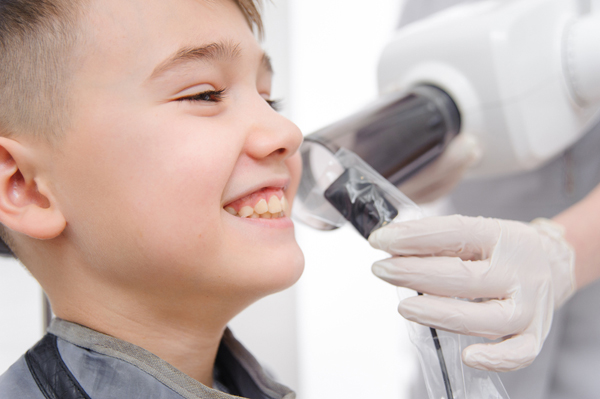
A pediatric dentist goes over dental X-ray imaging for children
Visual exams can only reveal so much, and dentists must use other means to see between the teeth and below the gumline. Note that dentists only use pediatric dental X-rays if the need arises. They will keep X-ray tests to a minimum, saving them for specific preliminary diagnoses or periodic monitoring. Here is what to expect from the X-ray procedure:
- The dentist will make the child wear a protective apron or thyroid collar
- With the caregiver’s help, the dentist will position the child on a chair or X-ray table
- The dentist will then set up the X-ray machine
- Next, the dentist will ask the child to bite down on a frame that contains a small X-ray film
- The dentist will then activate the X-ray machine so the rays pass through soft tissue to hit the X-ray film; at this step, the child should remain still to allow for clear images
Exposure to X-rays only takes a few seconds, making it easy for the child to stay calm. Dentists allow and often encourage guardians to be in the room with their child. Caregivers can prepare toddlers for the procedure by making a game of it at home. Here are a few answers to questions that explain kids’ X-rays in more detail.
1. Why and when would a young child need a dental X-ray?
An X-ray is a tool that helps with diagnosis and monitoring. Dentists will use pediatric X-rays to:
- Check for signs of tooth decay
- Look for developmental abnormalities in the oral cavity
- Monitor the eruption of permanent teeth
- Track the growth and development of the jaws, teeth, and dental arch
- Evaluate the extent of an injury and track its healing
The frequency of subsequent X-rays will depend on the results of the first set of images.
2. How often does a child need an X-ray?
It depends on the health of the young patient’s mouth. Children with a high risk of tooth decay will need annual X-rays to monitor their teeth. The same goes for children with developmental problems. The dentist may require more frequent imaging for serious oral health issues. Dentists prefer to take full or panoramic X-rays of their patient’s mouth once every three years.
3. Is exposure to X-rays a danger to the child’s health?
No, it only takes a few seconds and a low-intensity X-ray beam to take an image. Also, modern machines can focus X-ray beams to a specific location. Dentists will use lead aprons and throat guards to cover the child’s torso.
4. How does the X-ray machine work?
The X-ray machine consists of two parts: the generator and the detector. The generator produces the X-rays, and the detector captures them as they pass through the body. The images are then presented on a computer screen.
The generator produces the X-rays by firing electrons at a target material. The target material is usually made of tungsten or another heavy metal. When the electrons hit the target material, they release energy in the form of X-rays.
5. What are the safety precautions that are taken during an X-ray?
Several safety precautions are taken during an X-ray. The patient is always covered with a lead apron to protect them from the radiation. The room is also typically shielded so no one else in the room is exposed to the radiation. Finally, the person operating the X-ray machine will stand behind a lead shield to protect themselves.
6. What are a few common uses for pediatric X-rays?
There are many uses for pediatric X-rays. They can be used to diagnose cavities and bite issues and check developing teeth underneath gum tissues. X-rays can also be used to examine the heart, kidneys, and other organs.
7. What should I do if my child is scheduled for an X-ray?
If a child is scheduled for an X-ray, the parents should ask the pediatric dentist any questions that they have about the procedure. They should also tell the child to stay still during the X-ray so the images are clear.
We will care for your child’s oral health as they grow
Our pediatric dentist loves working with children, which is why they spent the extra years specializing in kids’ dentistry. They make it a point to only use pediatric dental X-rays if and when medical imaging is necessary.
If you are looking for comprehensive dental healthcare for your child, get in touch. Our dentist will be happy to monitor and maintain your child’s oral health for the long term.
Request an appointment here: https://www.grandparkwaypediatricdental.com or call Grand Parkway Pediatric Dental at (832) 579-0960 for an appointment in our Richmond office.
Check out what others are saying about our services on Yelp: Read our Yelp reviews.
Recent Posts
Kids dental crowns are caps that cover and replace natural tooth structures to restore their shape, function, and appearance. They are a popular restorative treatment that can address various dental issues. By investing in kids dental crowns, you are not only restoring the look of your child’s smile, but you are also safeguarding their future…
A sedation dentist can help make dental restorations, such as dental crown placement, a calm and tear-free experience for your child. If dental visits and procedures make your little one feel anxious or stressed, learning about relaxation techniques can help ease your worries. Sedation dentistry can help children feel comfortable and build the confidence to…
Kids dental crowns can restore decayed and damaged teeth, even when fillings are not an option. They can also be combined with other restorations, such as dental bridges, to replace missing teeth. Covering, reinforcing, or replacing teeth with crowns promotes good oral health. Crowns also support a child’s oral development, improving speech development, social skills,…
Kids dental crowns can treat many dental issues, including cavities that are too large for traditional filling material. Cavities can eat away and weaken children's teeth, requiring restorative treatments to protect the teeth's structure and function. Here are the details about when dental crowns can help after a cavity treatment.A pediatric dentist may suggest a…